Column shaped convection flow


As per recent study, The column shaped convection flow mechanism causes jovian planets to have eastward (superrotation) or westward (subrotation) winds. As per bifurcation,the atmosphere can stably settle into either situation.


In superrotation the equatorial region rotates faster than the planet itself (in Jupiter, Saturn). Column flow tilts outward so transfers momentum outward. While in subrotation the equatorial region rotates slower than the planet itself, or even in the opposite direction (in Uranus and Neptune). Column flow tilt inward so transfer momentum inward.


The small Rossby number indicates rotation(coriolis effect) dominates over inertia and convective columns form.

Source: https://arxiv.org/html/2510.08020v1#Sx2.F4


NH3 compounds found on Europa


By using Galileo spacecraft’s NIMS (Near Infrared Mapping Spectrometer) researchers found NH3 hydrate and other compounds on Europa (Jupiter’s moon). 


Scientists used Gaussian band fitting curve and 5th-degree polynomial continuum fit for identifying the 2.20μm absorption band. They used a Linear Mixing Model (each compound contribution is weighted by the proportion of the surface area it covers).


Source: https://arxiv.org/html/2510.02508v1#S2


Exoplanet density and host star


Scientists found that the rocky exo-planet's density is affected by its host star Magnesium to iron content. Higher [Mg/Fe] content in the star → lower its planet density.

This holds when considering only F G K type (temperature near sun) stars.


They used high-resolution spectroscopy which measures how much light the star emits at specific wavelengths.


Elemental content (Fe, Mg, Si, Al, C, etc.) were obtained using spectral line fitting method. Each element absorbs light at specific wavelengths — the depth of these lines shows how much of that element is present.


They used a Bayesian regression method here.

To measure how strong the relation is between density and element ratio Pearson Correlation Coefficient was calculated.


Source: https://arxiv.org/html/2510.04981v1


Tidal energy affects catastrophic threshold

 Catastrophic disruption threshold is a term used in planetary science and astrophysics to describe the minimum amount of energy required to completely break apart a celestial body (like an asteroid or satellite) so that it loses half or more of its total mass in a collision.


C constant depends on the effect of both tides and rotation.

δ measures orbital distance of the moon from the planet.

Qᴛᴅ (tidal-influenced catastrophic disruption threshold) decreases with the cube of distance  of moon from planet— the closer the moon, the easier to disrupt.


Source: https://iopscience.iop.org/article/10.3847/1538-4357/ae04e4


Dislocation

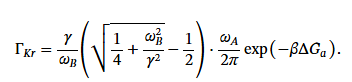
The study was done on effects of temperature, Langevin friction and external shear stress on the rates for dislocation to overcome the energy barrier interactions in FCC copper.

They used Kramers theory equations.(Kramers Rate Equation helps predict how dislocations (line defects) move through a crystal, which directly affects the strength, ductility, and failure of materials)


Langevin friction (gamma Y) refers to the damping force, or resistance to motion, that a particle experiences when interacting with a surrounding medium. Higher Langevin friction makes it slower for dislocations to move. It Does Not Change the Energy Barrier Itself.


At higher temperatures, the dislocation motion doesn't follow the usual straight-line pattern with temp which happens in Arrhenius behavior.


The non-Arrhenius behavior is stronger when the shear stress gets to near  τ cross which forces the enthalpy barrier to decrease. 


Source:

https://arxiv.org/html/2504.21246v1


Defects in Quartz

When radiation hits quartz, it excites electrons. electrons jump from the valence band (low energy) to the conduction band (high energy). This leaves behind holes in the valence band. The free electrons and holes can then move through the crystal.

If a defect (like an oxygen vacancy or an iron impurity) is present, it creates localized energy levels inside the wide bandgap. These levels can trap electrons or holes. The electron is trapped at an energy level lower than the conduction band.


Quartz is used in luminescence dating and ESR (Electron Spin Resonance) dosimetry, methods that measure radiation doses or date archaeological/geological samples. These applications depend on defects in the quartz lattice, which act as traps for charge carriers (electrons and holes) after exposure to radiation.


It is found that peroxy defects( two oxygen atoms bond directly to each other) can be formed in the presence of either excess Oxygen or due to the absence of Silicon (Si4+).


Oxygen vacancies and oxygen interstitials (excess oxygen) create trap states -they are responsible for electron and hole trapping, important for luminescence and ESR.


Passivated oxygen vacancies (with H or OH) do not create trap states- they neutralize defects.


https://arxiv.org/pdf/2504.18077


Wavefront Sensor


By using a convolutional neural network (CNN) researchers develop a method to calculate the Fried parameter with high accuracy using just one frame from a wavefront sensor (WFS), either Shack-Hartmann or Pyramid type. 

Shack-Hartmann Wavefront Sensor (SH-WFS) is used in Adaptive optics systems, to capture the incoming wavefront and convert it into an intensity image. SH-WFS consists of an array of micro-lenses, each focusing a small portion of the wavefront onto a spot on an image sensor. 

The displacement of these spots from the centre of each sub-aperture is proportional to the local wavefront gradient.

In Pyramid wavefront sensor (Py-WFS), a pyramid-shaped optical prism placed at the focal plane to split the incoming wavefront into four separate images, each sampling a different quadrant of the focal plane. 

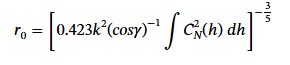
Fried parameter, r0, measures the strength of atmospheric turbulence. Cn^2⁢(h) is atmospheric refractive index structure constant at h height.

Source :https://arxiv.org/html/2504.17029v1


Speckle pattern

As the excitation light propagates through biological tissue it undergoes multiple scattering events. These scattering processes distort the original wavefront of the light and  its propagation paths is randomized, so interference pattern speckle pattern generates.

When the excitation beam is tilted by a small angle, the speckle pattern at the object plane remains unchanged, this is called memory effect.


In deep tissue imaging laser scanning microscopy is ineffective. Here the point spread function (PSF) is used having non linear behavior with fluorescence intensity.


Source:

https://arxiv.org/html/2504.10423v1#Sx1.F2


Comets’ brightness


Brightening is due to a combination of observing geometry, as the comet approaches both the Sun and the Earth, and increasing back-scattering cross-section.


Total Magnitude(brightness) of comet:

 M1 absolute magnitude of the comet (a baseline brightness value).

Δ: geocentric distance (distance between the comet and Earth, inAU).

r: The heliocentric distance (distance between the comet and the Sun, in AU).

K1: brightness slop


Dynamically new comets have a lower heliocentric brightening slope (kr), meaning they brighten at a slow rate.

Higher kr means the comet brightens more rapidly as it goes near the sun. Older comets tend to have more scattered kr values due to surface evolution and patchy mantles of refractory material.


New dynamically young comets often experience strong post-perihelion fading because they have more pristine, volatile-rich surfaces.


New comets appear intrinsically brighter than old comets because they -contain pristine, highly volatile ices that sublimate easily, have higher surface activity with a larger fraction of the nucleus actively.


The dynamically new comets produce more CO2 than CO, while dynamically old comets appear to be more CO-dominant.


source:

https://arxiv.org/html/2504.00565v1


Meteoroid in earth atmosphere:

Fragmentation, rather than ablation, is the dominant mechanism of mass loss. Here Rayleigh–Taylor (Hydrodynamic )instability occurs at the interface between two fluids of different densities, lighter fluid is pushing the heavier fluid.

Meteoroid Trajectory equation:

Cd is the drag coefficient of meteoroid, ρ is atmospheric density, A is the cross-sectional area, m is the mass of the impactor, g(z) gravitational acceleration


Mass ablation: It  is the process by which an object moving through an atmosphere loses material due to intense heat and pressure.

.

ξ is the energy required to heat the surface, Ch heat transfer coefficient.


Fragmentation may occur either when the stagnation pressure of the atmospheric flow exceeds the material’s compressive strength.


source:

https://arxiv.org/html/2503.22632v1